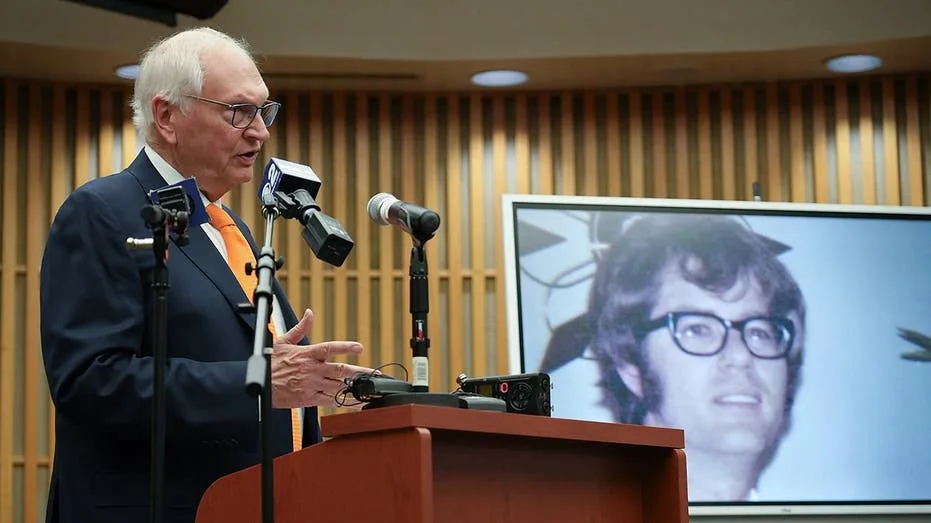
A man who died of cyanide poisoning in an Idaho church over four decades ago, long known only as the "Unknown Wanderer," has finally been identified. This breakthrough has prompted investigators to explore a potential connection between the man's past and the still-unsolved 1982 Chicago Tylenol murders.
The individual, identified by the Ada County Sheriff's Office in Boise on Wednesday, is Dr. Mathew Francis Betkouski, an organic chemist. His history includes discussions about cyanide and various poisons, according to authorities.
While investigators have stated they cannot definitively place Dr. Betkouski in Chicago during the critical final week of September 1982, when seven individuals tragically died after consuming cyanide-laced Tylenol capsules, they are not currently naming him as a suspect in those deaths.
However, Dr. Park Dietz, a forensic psychiatrist who advised on the initial Tylenol investigation and has since reviewed the evidence pertaining to Betkouski, offered a more definitive perspective.
"It's an extraordinary thing to have been around at the beginning in 1982, and now today in 2026, to see very likely closure," Dietz commented.
Dietz further noted that groups of forensic psychiatrists, psychologists, and criminal profilers, who were presented with information about Betkouski anonymously, largely considered him a plausible suspect in the Tylenol poisonings.
Decades-Old Mystery Solved
Dr. Betkouski's death occurred on December 4, 1982, after he entered Sacred Heart Catholic Church in Boise. Authorities concluded he succumbed to cyanide poisoning, but he carried no identification, and his fingerprints yielded no matches, leaving his identity a mystery for decades.
The breakthrough came when investigators traced one of nearly 30 keys found on Betkouski to Jacksonville, Florida, where he had previously resided. DNA samples recovered from his wallet were later compared with a sample from his brother, ultimately confirming his identity.
Potential Tylenol Connection
Following Betkouski's identification, investigators unearthed several details that raised significant questions regarding the Tylenol case.
- A former professional associate recalled Betkouski discussing the concept of a "perfect crime" and cyanide.
- Another scientist recounted Betkouski remarking on the possibility of introducing poison into over-the-counter capsules.
Authorities also discovered a map of Chicago and a bottle of sodium cyanide among his personal effects stored at his family's residence in Los Angeles. Investigators were careful to point out that the poison found was sodium cyanide, distinct from the potassium cyanide implicated in the Tylenol murders.
While photographs indicated Betkouski had visited Chicago, investigators determined these images were likely taken in December 1981. They have not been able to establish that he returned to the city at the time the Tylenol poisonings occurred.
Betkouski vanished from his New Mexico home on October 15, 1982, and was found deceased in Boise just seven weeks later, having reportedly altered his appearance.
Ongoing Investigation
The findings from the Ada County Sheriff's Office have been shared with investigators in the Chicago metropolitan area. Authorities are now actively seeking any information regarding Betkouski's movements and communications during 1982.
"This isn't over," stated Ada County Sheriff Matt Clifford, emphasizing the continued nature of the inquiry.