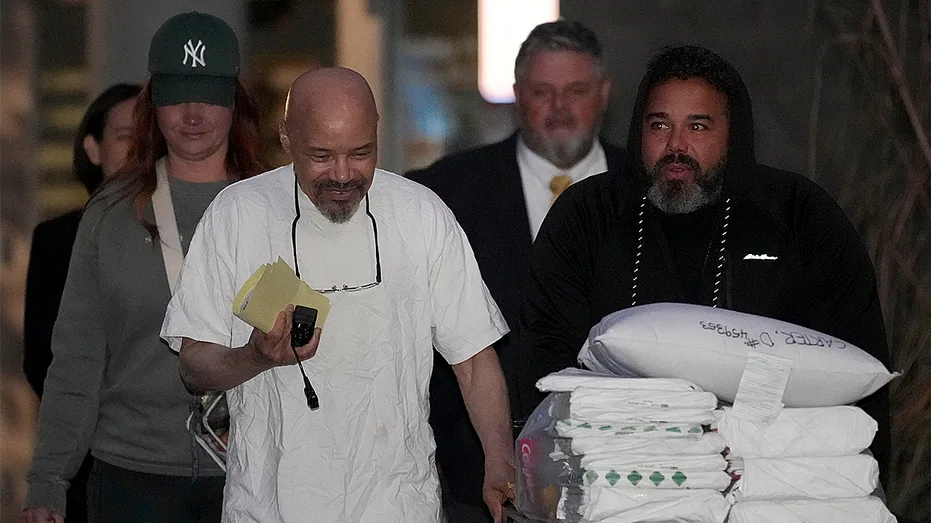
A Utah man, Douglas Stewart Carter, who spent decades on death row following his conviction for the 1985 murder of a police chief's aunt, has been released from custody. Prosecutors stated that recent DNA analysis definitively excluded him as the source of genetic material found on crucial evidence from the crime scene.
Carter, 71, was granted bail late Monday, a decision met with objections from the victim's family. He is required to wear a GPS monitoring device as he awaits a new trial for the killing of Eva Olesen. Olesen was discovered tied, stabbed, and shot within her Provo residence on February 27, 1985, in what authorities initially believed to be a robbery.
The presiding judge also issued an order prohibiting Carter from having any contact with Olesen's relatives.
The Utah Supreme Court previously mandated a new trial last year, citing instances of misconduct by investigators involved in the original case.
Throughout his incarceration, Carter has consistently asserted his innocence, contending that his signed confession was obtained under duress.
Initially, no physical evidence directly connected Carter to the crime scene. His conviction rested primarily on his confession and the testimonies of two witnesses who claimed he boasted about Olesen's murder; however, these witnesses later retracted their statements.
The recent DNA analysis, with results received on September 22, definitively ruled out Carter as a potential match for blood discovered on a doorknob and genetic material retrieved from the handle of the knife used in Olesen's stabbing.
Judge Derek Pullan acknowledged that these DNA findings significantly weaken the prosecution's case against Carter. Nevertheless, he noted that a future jury could still potentially conclude Carter was responsible for Olesen's death.
"This is going to be a lot for him,"
Carter's son, Tyler Anger, commented on Monday while awaiting his father's release.
According to Carter's attorney, Neal Hamilton, Carter will reside in an extended-stay hotel situated close to Anger. Anger was adopted as an infant and only learned about his biological father's conviction much later in life.
Hamilton also indicated that Carter would require therapy to cope with the profound impact of his prolonged imprisonment.
"If the state of Utah had their way, he would have been executed 15, 20 years ago before we discovered the misconduct,"
Hamilton stated.
Hamilton has implored prosecutors to move for the dismissal of the aggravated murder charge that remains pending against his client.
While a two-month retrial was scheduled for next year, county prosecutors recently withdrew their intent to seek the death penalty in this case.
Utah County prosecutor Erwin Petilos informed the judge on Monday that a reassessment of Carter's bail was considered "necessary and fair" as the state continues its review of the remaining evidence.
The Original Investigation and Controversial Confession
At the time of Olesen's murder, Carter was residing with his mother in Utah.
Court documents indicate that by April 1985, Carter had left Utah, believing he was a suspect in an unrelated assault. He was apprehended two months later in Nashville, where he signed a confession during an interrogation conducted by a Provo detective.
Carter later recanted, asserting that his confession was coerced and that he falsely admitted to the crime after sustained threats from law enforcement.
His initial trial resulted in a conviction and death sentence, notably without any defense witnesses being called to testify. Following a 1992 retrial, Carter was again sentenced to death, and subsequent appeals filed by his legal team were denied by Utah courts.
Misconduct and Recanted Testimonies
A significant development occurred in 2011 when the two witnesses from Carter's original trial were located in Mexico. They confessed to being instructed to provide false testimony in court and admitted receiving cash and gifts from police in exchange for their statements. These witnesses further alleged that police directed them not to disclose these payments and that both police and prosecutors threatened them and their son with deportation if they failed to implicate Carter in the murder.
Over a decade of legal battles followed before the Utah Supreme Court intervened last year, mandating a new trial and specifically citing "multiple instances of intentional misconduct" by both police and a prosecutor. In response to this order, a DNA analysis of the evidence was performed. Prosecutors confirmed that the results, received last week, excluded Carter from the crime scene.
Prosecutors have declined to comment on whether they intend to utilize the new DNA evidence to identify other potential suspects whose genetic material might match.
Defense Raises Questions About Other Suspects
Attorneys representing Carter, who is Black, have previously asserted that witnesses observed a White man fleeing the crime scene. They also contend that an investigator deliberately suppressed evidence that could have implicated other individuals, including the victim’s husband, Orla Olesen.
According to the defense team, prosecutors were reportedly close to filing charges against Orla Olesen. However, a Provo police lieutenant allegedly advised against it, expressing a desire to continue the investigation. Subsequently, Carter was identified as a suspect, as documented in court records.
Orla Olesen, who passed away in 2009, had informed police that he discovered his wife deceased in their home, partially undressed and with her hands bound behind her back.
Victim's Family Expresses Concerns
During the bond hearing on Monday, Theresa Olesen, Eva Olesen's daughter-in-law, conveyed that her family harbored "serious concerns" regarding Carter's release.
"By golly we were hoping for a concrete match,"
Olesen remarked concerning the DNA analysis, adding,
"It doesn't mean he wasn't there."
"We just want justice for Eva. And if he had any part of it we want that to be known,"
she concluded.