Beijing has significantly enhanced its military footprint in the Red Sea, transforming the area into a critical surveillance zone, according to a former Pentagon official. This development follows a recent report that highlighted upgrades to China’s facilities in Djibouti, Africa, located merely six miles from a key U.S. military base that costs $66 million annually to operate.
The report, issued by the Washington-based Center for Strategic and International Studies (CSIS), identified new infrastructure likely to enable the Chinese military to monitor the activities of other armed forces in the vicinity. While the report clarified that it could not confirm active interception of communications, the capabilities suggest a strong intent for surveillance.
Morgan Murphy, who served as a press secretary for Mark Esper when he was secretary of defense during the first Trump administration and held a position in the Trump White House, commented on China's intentions. He stated, “What China is clearly doing is building eavesdropping capabilities. That seems to be their aim.”
Murphy further elaborated, “Beijing has clearly wiretapped the Red Sea. When you build a 30-meter (100-foot-wide) satellite dish and cover it with a dome, so nobody can see where it's pointing, it's pretty clear you're up to no good.” He also praised the think tank, noting that “the specificity here reflects the thorough research we expect out of CSIS.”
Advanced Surveillance Infrastructure
The CSIS report specifically detailed a large facility on the southeastern side, which includes a control building, three 30-meter dipole antennas for high-frequency communications, and two smaller antennas designed for very and ultra-high frequencies. Additionally, the site features three mobile satellite dishes, four likely 5G towers, and what CSIS described as a “radome” concealing an unidentified asset.
The report also pointed to two new communications installations that have appeared since 2024. These are believed to be part of a C4ISR (Command, Control, Communications, Computers, Intelligence, Surveillance, and Reconnaissance) command architecture, which would significantly boost China’s capacity to intercept signals, track naval movements, and communicate with Beijing while observing foreign militaries in the region.
Such facilities would furnish China with “a much more robust picture of the operating environment in the region,” the report concluded.
Murphy underscored the strategic importance of the location: “This isn’t a supply depot — it’s a 50-yard line seat over America’s power projection and the U.S. Navy.” He acknowledged the vast network of U.S. bases globally, stating the U.S. has “128 bases in more than 51 countries — China has just one.”
However, he emphasized, “But look at the location — a few miles from Camp Lemonnier, overlooking the choke point that moves roughly a sixth of global sea trade. Great powers don’t plant listening posts next to rival fleets for 'logistics.'”
Murphy drew historical parallels, noting that “Britain held Gibraltar to see who entered the Med while Japan’s island radios came before the runways. The Soviets’ overseas sites were never just about fuel and Beijing is running that playbook on the Red Sea.”
Diplomatic Responses and Past Tensions
Despite China’s Foreign Ministry spokesperson Guo Jian stating the country was “unaware of the specific situation” and portraying China as a “builder of international peace,” Reuters reported that the new facilities provide Beijing with a clear view of regional operations.
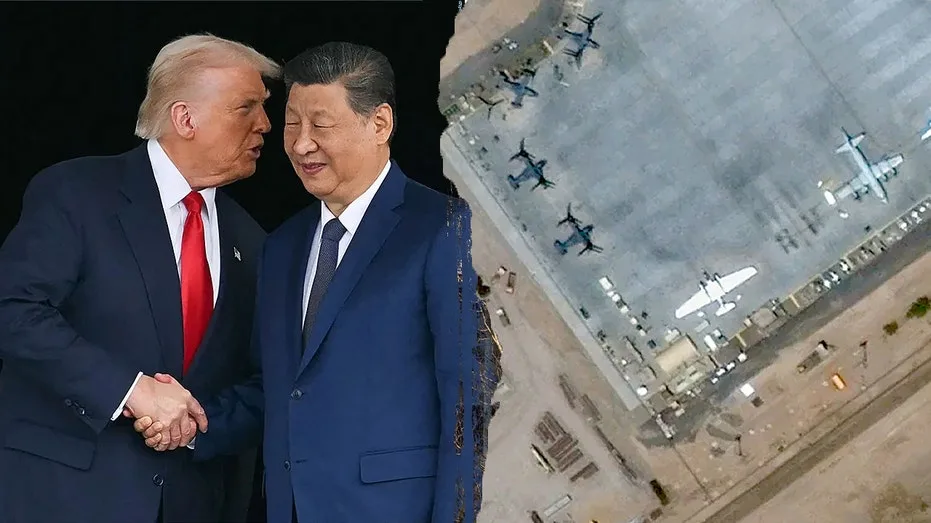
Murphy commented on the timing, observing, “The new report is helpful in framing the conversation, and it comes at an awkward time for China because Xi Jinping is visiting the White House on the 24th of this month.”
He predicted the issue would be raised during the visit, adding, “I'd bet a box of donuts this issue comes up. There is going to be public exposure of this, which Chinese leadership isn't used to. They aren't used to being asked tough questions by the press.”
Former President Donald Trump previously addressed Chinese intelligence activities, acknowledging during a discussion aboard Air Force One that China “spies on us” just as “we spy on them.” Trump’s remarks followed a report by The Wall Street Journal linking a Chinese entity's support to high-resolution satellite imagery used by Iran before a deadly missile attack on U.S. troops in Jordan.
“They basically do what we do,” Trump remarked, adding, “Xi has behaved reasonably well, and we behave reasonably well. ... You know what they say? That China spies on us. I say you're right, and we spy on them, too,” as reported by Reuters.
Murphy reiterated this sentiment, stating, “Nations spy on each other — allies and adversaries alike.”
He continued, “It is a very old playbook, and listening posts all over the world are typical of great powers, but where the metal hits the floorboard is when you try to use that information.” He further noted that while China may “keep tabs on us, but they cannot project power like the United States can.”
The close proximity of China's facility to U.S. operations remains a significant concern. Situated less than six miles from Camp Lemonnier — the primary U.S. counterterrorism hub in Africa — and near French, Italian, and Japanese installations, the site has a history of contentious interactions with U.S. forces.
“We are just right around the corner from China, and yet it's not a cooperative relationship,” Murphy explained.
“Back in 2018, they lasered two of our C-130 pilots' eyes who suffered lasting damage from that incident. Beijing denied it, of course, but we know the truth.”
During the 2018 incident, the Pentagon formally protested to China after military-grade lasers were directed at American pilots attempting to land at Camp Lemonnier, resulting in minor injuries. Although Beijing dismissed the accusations as “groundless,” the confrontation highlighted the potential for conflict between military forces operating from adjacent bases.
Strategic Importance and Future Outlook
Murphy emphasized the unique strategic positioning of China's sole overseas base. “China has one overseas base. The United States has more than 128 — by some counts, over 700 installations around the world,” he said.
“So it's significant that China has chosen to place its only overseas base six miles from ours in Djibouti. It is hugely strategically important, which is why, of course, we're there.”
He pointed out that Camp Lemonnier is “our only base on the continent of Africa,” and shares a “parking lot” with Japanese and Italian bases. “At $66 million a year, it's the best money Americans spend on our defense budget, full stop.”
The Bab el-Mandeb Strait, a critical maritime choke point, handles nearly 16% of global sea trade. With substantial crude oil shipments, Houthi attacks, and pipeline disruptions, the region has seen an increased military presence.
“Interference by China is in their strategic interest. They don't want to see the United States able to control their oil supply,” Murphy stated.
“China is far more reliant on Middle Eastern oil than the United States. China imports a huge portion — around 33% or more — of their daily oil needs and is highly reliant on long sea lines. You are seeing this muscle-flexing because they are far more reliant on Middle Eastern oil than we are.”
Murphy also highlighted the distinction between intelligence gathering and power projection. “Having intelligence is one thing, but you must have the ability to act on it. You need assets in the region,” he said.
“China doesn't have major combat assets outside their region because they lack a blue-water navy to project power outside the first island chain yet.”
He concluded with a warning: “That is coming, and they are working towards it quickly. Americans can take comfort in the fact that they don't have that capacity today, but we must stay alert because the only thing that subdues a threat is a ready posture.”